


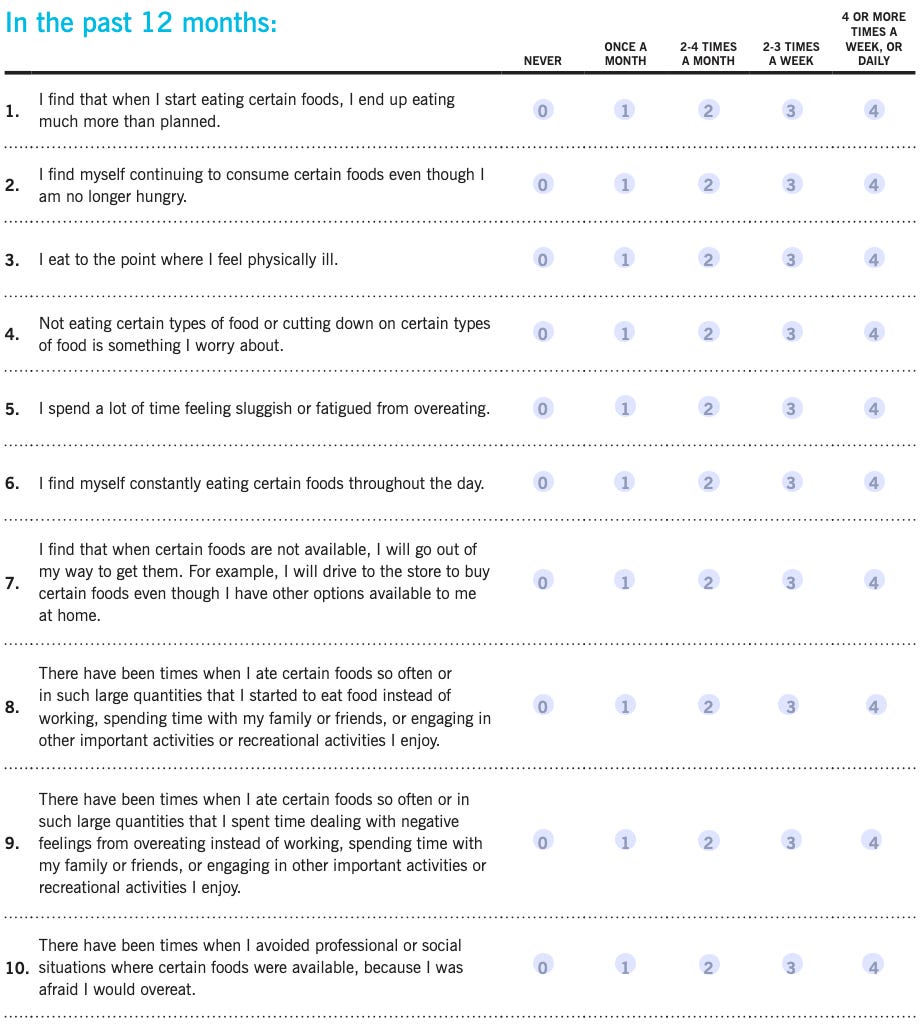
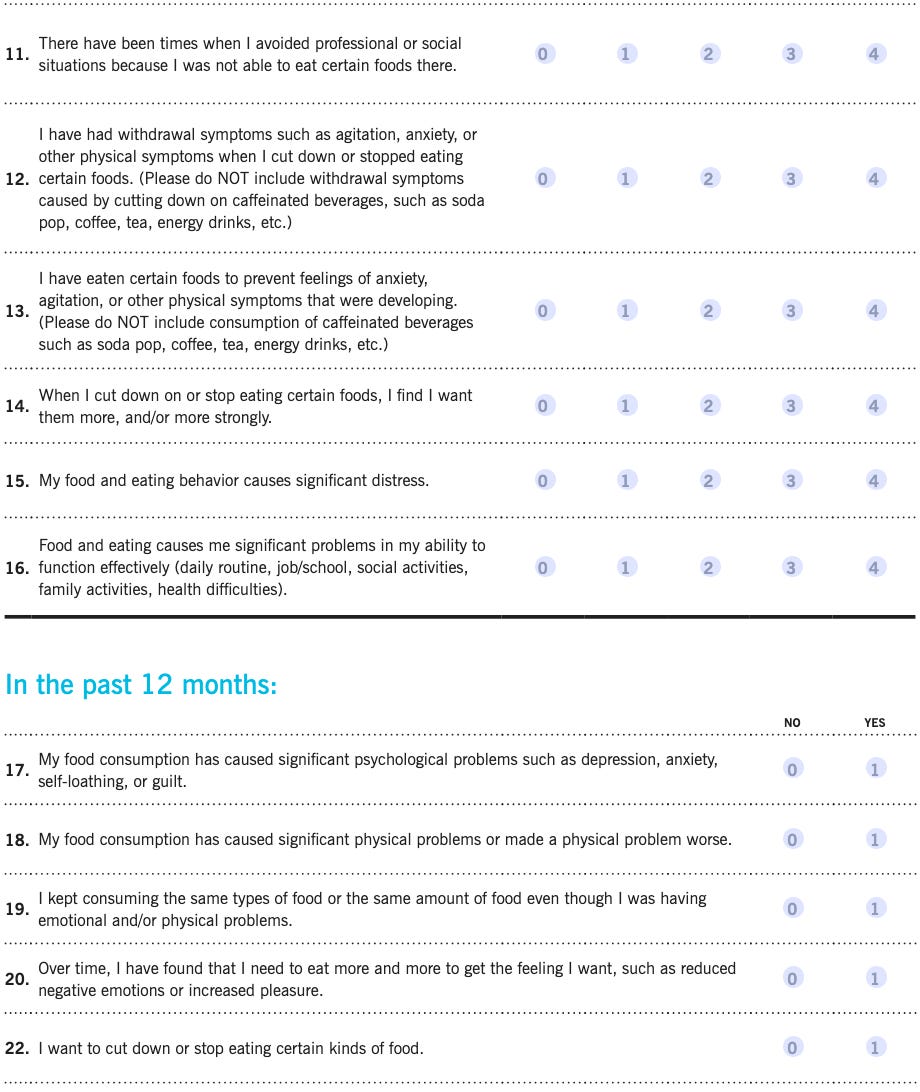
The “Yale Food Addiction Scale,” featured in the book Your Optimal Health (Hardie Grant ed.), is a questionnaire designed to identify eating behaviors similar to an addiction, based on the DSM-5 (Diagnostic and Statistical Manual of Mental Disorders) criteria. Developed by Ashley Gearhardt and her team in 2009, this scale evaluates whether a person shows signs of food dependence, particularly toward foods high in sugar, fat, and salt.

Take the test here, or below.
Important Information Before You Start
Purpose: This survey asks about your eating habits over the past year.
Target Foods: When the questions mention “certain foods,” please think of any food similar to these:
Sweets: Ice cream, chocolate, donuts, cookies, cake, candy.
Starches: White bread, rolls, pasta, rice.
Salty Snacks: Chips, pretzels, crackers.
Fatty Foods: Steak, bacon, hamburgers, cheeseburgers, pizza, French fries.
Sugary Drinks: Soda/pop.
Disclaimer: This is an awareness tool. Unless professionally qualified, do not use this for medical diagnosis. If you feel you have a serious problem with disordered eating, please consult a healthcare professional.
How to Understand Your Results
The YFAS scores are based on 8 symptoms derived from the DSM criteria for dependence.
Step 1: Check for “Symptom Presence” A symptom is considered “present” if you meet the threshold for the related questions:
Loss of Control: (Qs 1, 2, or 3) Score of 4 or higher.
Unsuccessful attempts to quit: (Qs 4, 21, 22, or 23) Look for persistent desire or failed attempts.
Time spent / recovery: (Qs 5, 6, or 7) Score of 4 or higher.
Reduction of activities: (Qs 8, 9, 10, or 11) Score of 4 or higher.
Continued use despite problems: (Q 19) Answered “Yes”.
Tolerance: (Q 20) Answered “Yes”.
Withdrawal: (Qs 12, 13, or 14) Score of 4 or higher.
Significant Impairment/Distress: (Qs 15 or 16) Score of 4 or higher.
Step 2: Determine Addiction Level
0-1 Symptom: No food addiction.
2-3 Symptoms: Mild food addiction.
4-5 Symptoms: Moderate food addiction.
6+ Symptoms: Severe food addiction.
Conclusion
If your score indicates moderate or severe dependency, don’t panic. Understanding the biological impact of ultra-processed foods on our brain’s reward system is the first step toward reclaiming balance. Strategies like mindful eating, stress management, and a microbiome-friendly diet can help significantly.
References: Gearhardt, A.N., Corbin, W.R., & Brownell, K.D. (2009). Preliminary validation of the Yale Food Addiction Scale. Appetite.